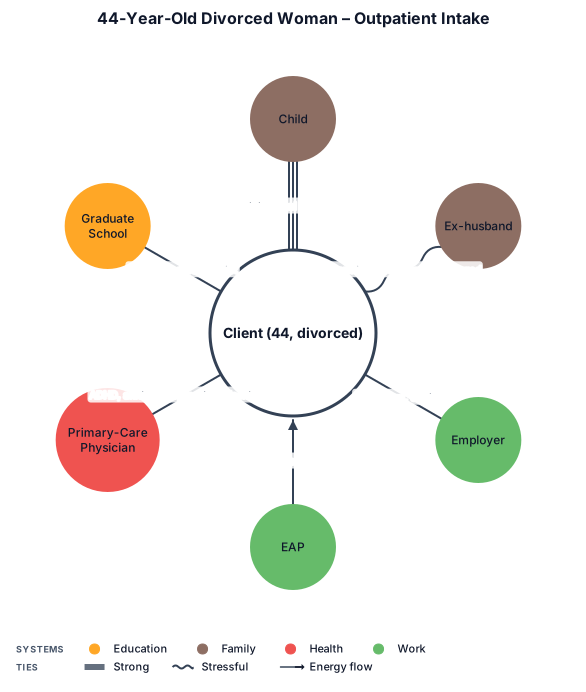
The client is a 44-year-old divorced woman who was referred for outpatient mental health services through her employer's Employee Assistance Program (EAP). She reports experiencing increased symptoms of depression, anxiety, low mood, decreased motivation, and difficulty managing daily responsibilities. The client has joint legal custody of her child, although the child currently spends more time living with the father because the client relocated farther away from the child's school district. The change in parenting arrangements has been emotionally difficult for her and has contributed to feelings of sadness and guilt. She has been employed with the same employer for many years but has recently experienced decreased motivation to attend work and frequently uses intermittent FMLA when her mental-health symptoms become difficult to manage. When she does not have enough accrued sick leave to cover an absence, the resulting reduction in her paycheck creates additional financial stress, which contributes to her depression and anxiety. The client reports a history of anxiety, depression, and ADHD, initially diagnosed by her primary-care physician in 2008. Her intermittent FMLA is related to these conditions. Medically, the client has one functioning kidney, which currently does not require treatment or interfere with her daily functioning. She was also diagnosed with Hashimoto's thyroiditis in 2025. Her medical history should be considered when assessing symptoms such as fatigue, decreased energy, mood changes, and difficulty concentrating rather than automatically attributing all symptoms to depression. The client recently returned to graduate school while continuing to work and reports difficulty adjusting her schedule and balancing employment, school, parenting, financial responsibilities, and her personal needs.
Diagram Examples from Real Visitor Prompts
Browse eligible diagrams shared by FreeDiagram visitors, inspect the exact prompts, and build your own version.
Browse 3261 real creationsEcomap
Showing 1–19 of 19. No stock examples or system defaults. Choose a tool, study a real result, then reopen its prompt as your starting point.
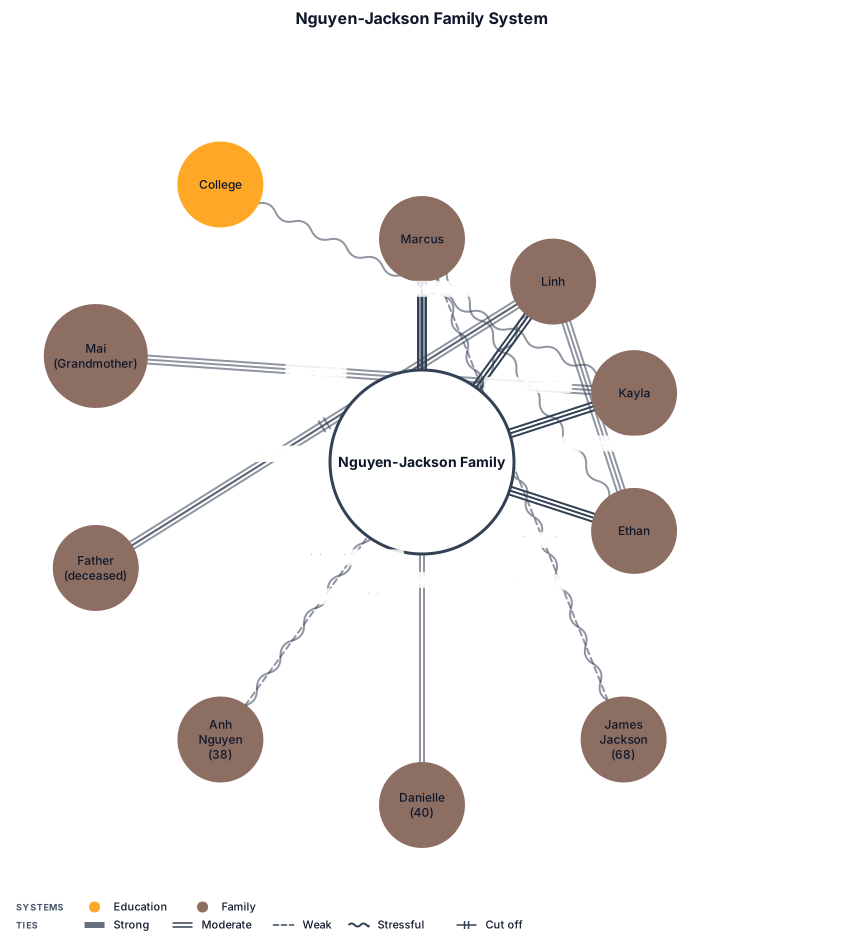
Marcus has a strained relationship with his father, James Jackson (age 68), who lives in another state. James has a history of alcohol use and was largely absent during Marcus’s childhood. Marcus maintains a closer relationship with his younger sister, Danielle (age 40), who provides emotional support via phone but lives far away. Linh has a younger brother, Anh Nguyen (age 38), who lives nearby but is minimally involved in caregiving for their mother. Linh expresses resentment about this imbalance. Linh’s father is deceased, having died 10 years ago from a stroke. The family describes him as a stabilizing and supportive figure. Kayla is very close to her grandmother, Mai, but feels pressure to succeed academically as the first in the family to attend college. She has recently begun withdrawing socially and reports anxiety about leaving home. Ethan is closely attached to his mother but is frequently in conflict with Marcus. Marcus has a strained relationship with his father, James Jackson (age 68), who lives in another state. James has a history of alcohol use and was largely absent during Marcus’s childhood. Marcus maintains a closer relationship with his younger sister, Danielle (age 40), who provides emotional support via phone but lives far away. Linh has a younger brother, Anh Nguyen (age 38), who lives nearby but is minimally involved in caregiving for their mother. Linh expresses resentment about this imbalance. Linh’s father is deceased, having died 10 years ago from a stroke. The family describes him as a stabilizing and supportive figure. Kayla is very close to her grandmother, Mai, but feels pressure to succeed academically as the first in the family to attend college. She has recently begun withdrawing socially and reports anxiety about leaving home. Ethan is closely attached to his mother but is frequently in conflict with Marcus.
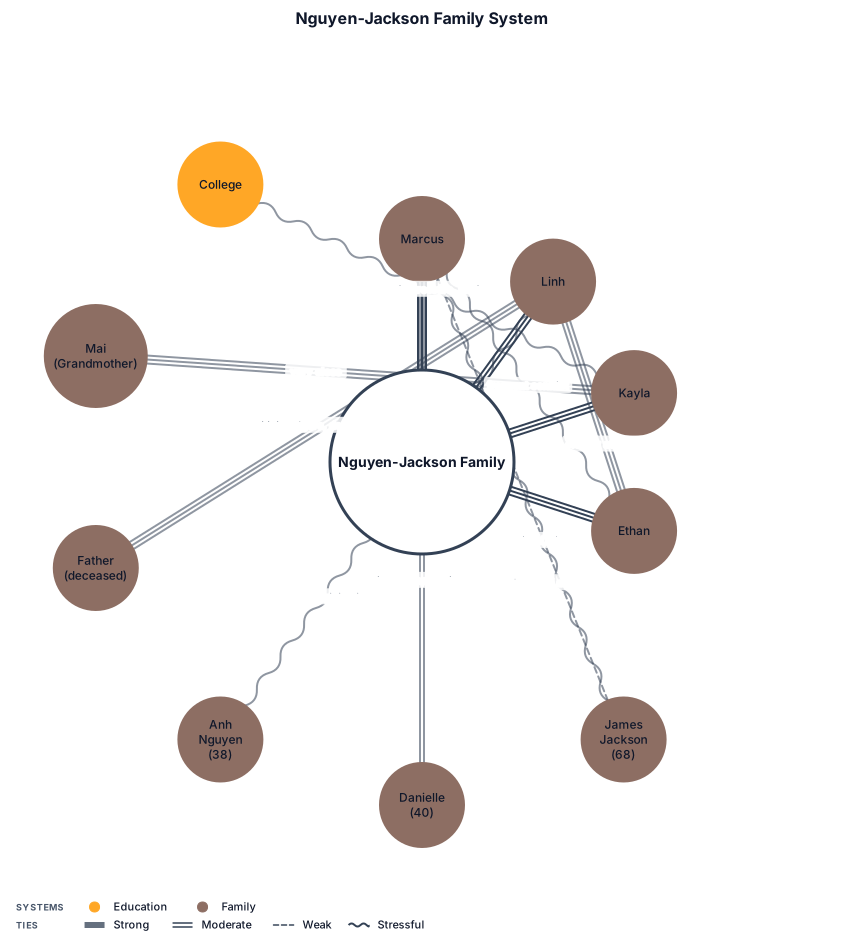
Marcus has a strained relationship with his father, James Jackson (age 68), who lives in another state. James has a history of alcohol use and was largely absent during Marcus’s childhood. Marcus maintains a closer relationship with his younger sister, Danielle (age 40), who provides emotional support via phone but lives far away. Linh has a younger brother, Anh Nguyen (age 38), who lives nearby but is minimally involved in caregiving for their mother. Linh expresses resentment about this imbalance. Linh’s father is deceased, having died 10 years ago from a stroke. The family describes him as a stabilizing and supportive figure. Kayla is very close to her grandmother, Mai, but feels pressure to succeed academically as the first in the family to attend college. She has recently begun withdrawing socially and reports anxiety about leaving home. Ethan is closely attached to his mother but is frequently in conflict with Marcus. Create a Genogram Include at least three generations Identify relationship quality (close, distant, conflictual) Note significant events (death, migration, estrangement) Highlight patterns (e.g., caregiving roles, mental health, substance use)
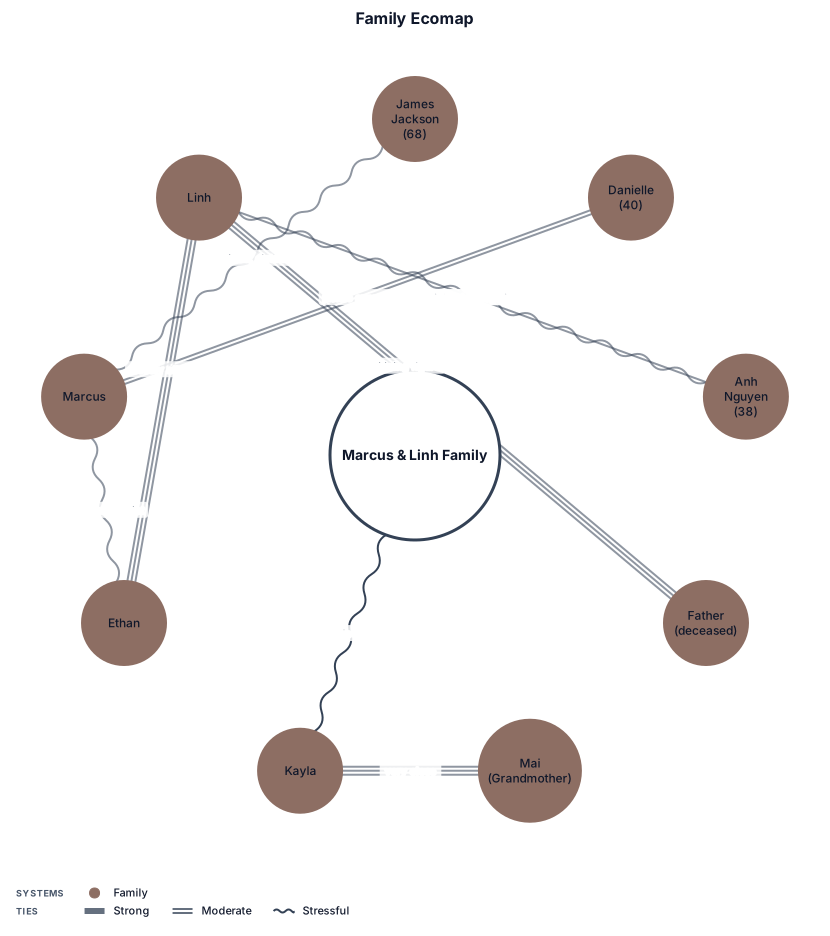
Marcus has a strained relationship with his father, James Jackson (age 68), who lives in another state. James has a history of alcohol use and was largely absent during Marcus’s childhood. Marcus maintains a closer relationship with his younger sister, Danielle (age 40), who provides emotional support via phone but lives far away. Linh has a younger brother, Anh Nguyen (age 38), who lives nearby but is minimally involved in caregiving for their mother. Linh expresses resentment about this imbalance. Linh’s father is deceased, having died 10 years ago from a stroke. The family describes him as a stabilizing and supportive figure. Kayla is very close to her grandmother, Mai, but feels pressure to succeed academically as the first in the family to attend college. She has recently begun withdrawing socially and reports anxiety about leaving home. Ethan is closely attached to his mother but is frequently in conflict with Marcus.
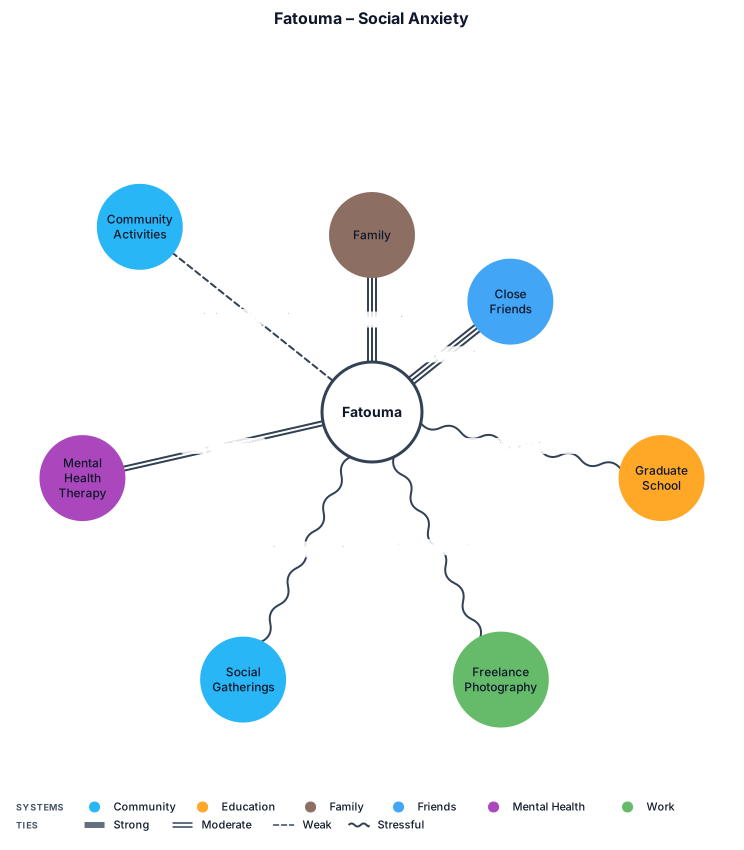
Fatouma – Social Anxiety Family: Strong, supportive relationship. Provides emotional support. Close Friends: Strong, supportive relationship. Important source of emotional support. Graduate School: Currently pursuing a master's degree. Social anxiety creates stress in academic and social situations. Freelance Photography: Stressful relationship due to anxiety when interacting with clients, attending events, and accepting public assignments. Social Gatherings: Stressful relationship. Fear of negative judgment and avoidance of social situations. Mental Health Therapy: New, developing supportive relationship. Community Activities: Limited connection due to social anxiety.
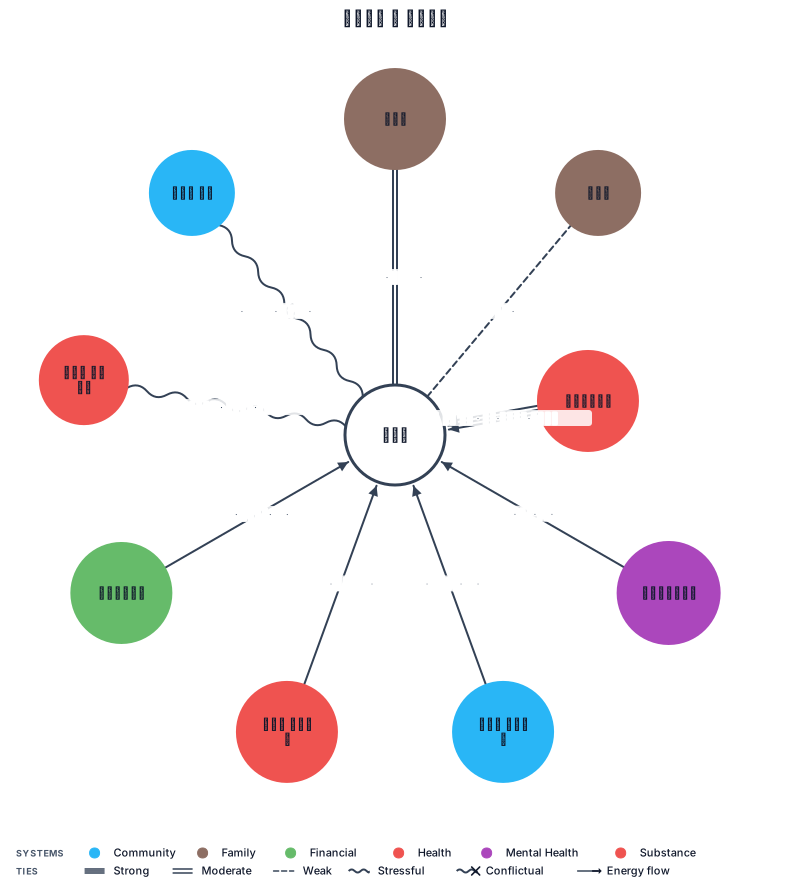
관계체계 관계 개입방향 어머니 잠재적 지지관계 동의 하에 가족교육·정서적 지지 아버지 거리감 있는 관계(가상) 관계 수준 추가사정 중독상담기관 강한 공식 지원 상담·재발예방·사례관리 정신건강의학과 연계 필요 우울·불안·외상 평가 성폭력 지원기관 연계 필요 피해회복·안전·법률지원 성건강 의료기관 연계 필요 성건강검사·치료 고용복지기관 연계 필요 직업훈련·취업·경제자립 온라인 약물관계 위험관계 접촉감소·안전계획 성매매 관계 위험·스트레스 관계 위험감소·대체 생계수단 마련
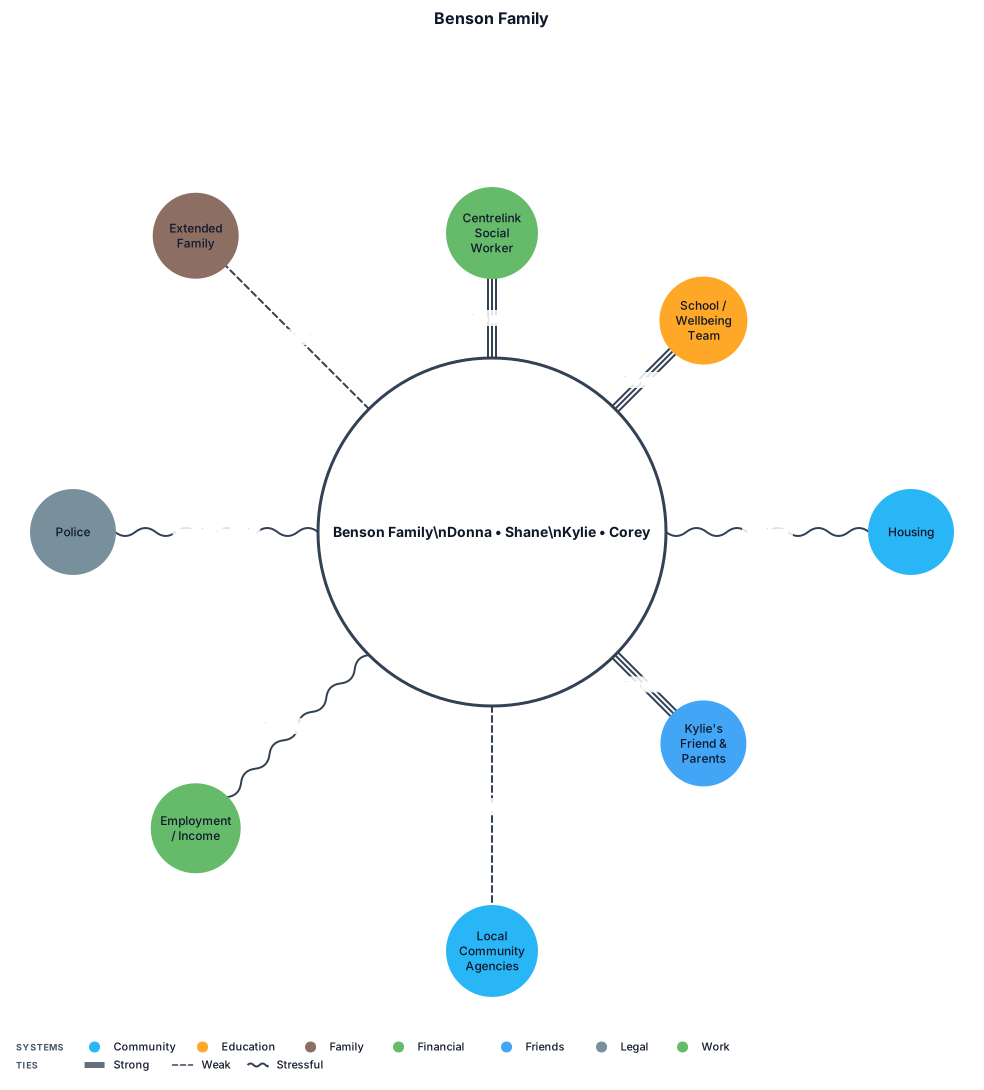
Can you generate an ecomap based on this Use solid line for active, supportive connection Dashed line for stressed connection Dotted line for formal, limited connection Main: BENSON FAMILY Donna • Shane Kylie • Corey Centrelink social worker School / wellbeing team Housing Kylie's friend & friend's parents Local community agencies (suggested) Employment / income Police (warning to Kylie) Extended family (tenuous links) Key: solid = active/supportive connection; dashed = strained or stress-related connection; dotted = limited, formal, or potential connection. Ecomap reflects information in the case and should be checked collaboratively with family members.
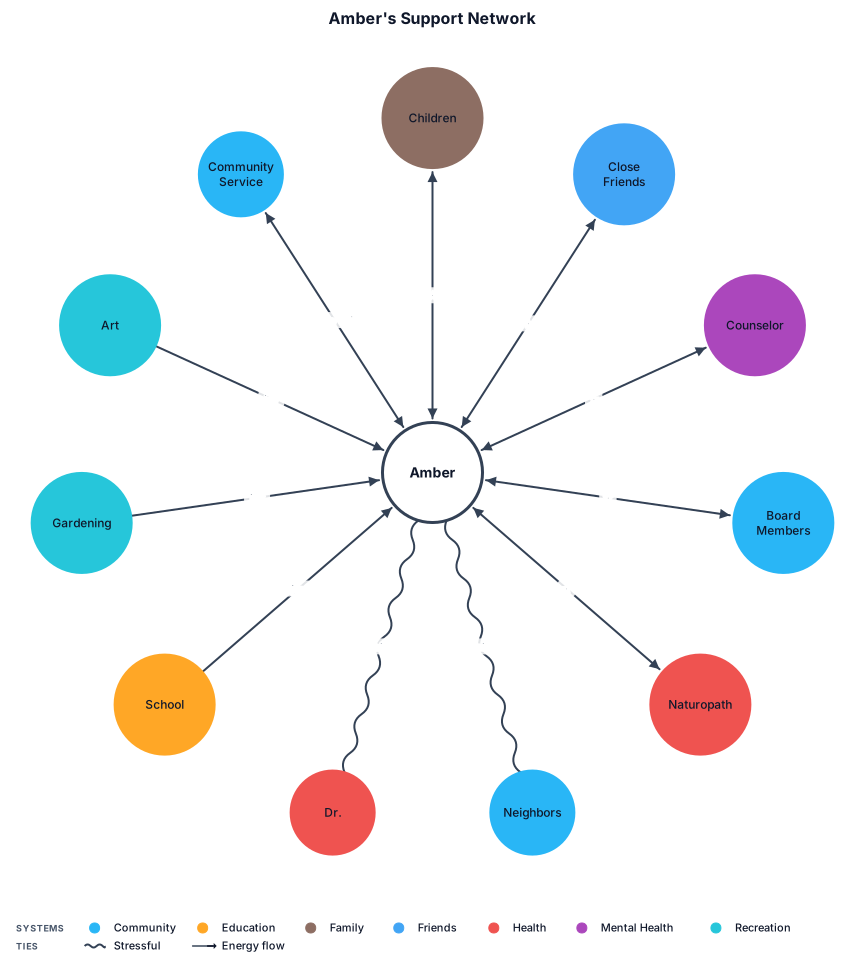
Make a comp of Amber who has positive reciprocal relationships with her children, close friends, counselor, board members, and Naturopath. She has negative strained relationships with her neighbors and her Dr. she finds joy and positivity from school, gardening, and art. Community service uses a lot of energy but brings joy. Highlight positive relationships with a star
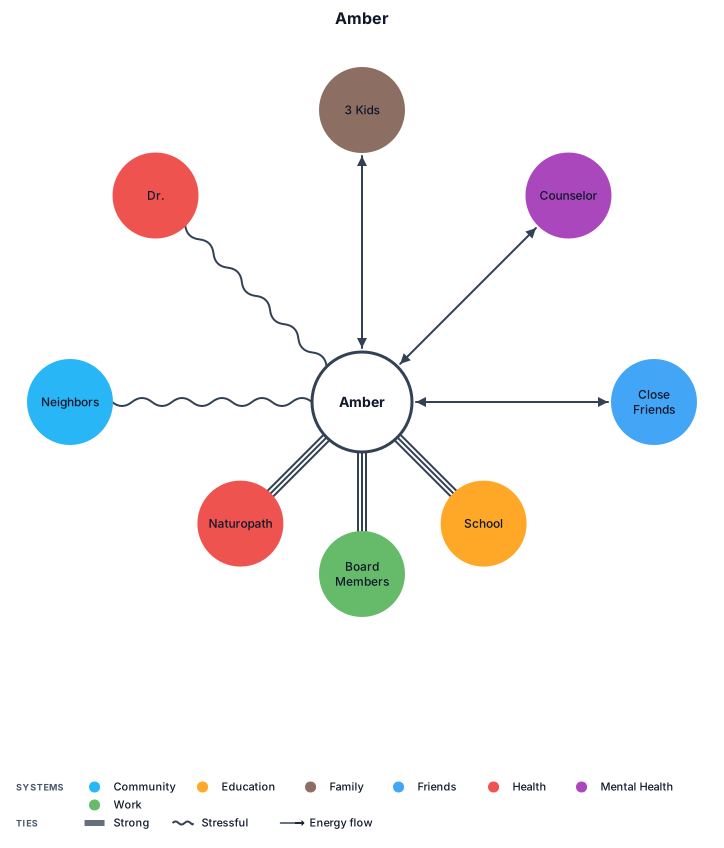
An ecomap for Amber she is a student who enjoys school she has a positive reciprocal relationship with her 3 kids, her counselor and a couple close friends. She has a positive relationship with her board members and naturopath and a negative relationship with her neighbors and Dr
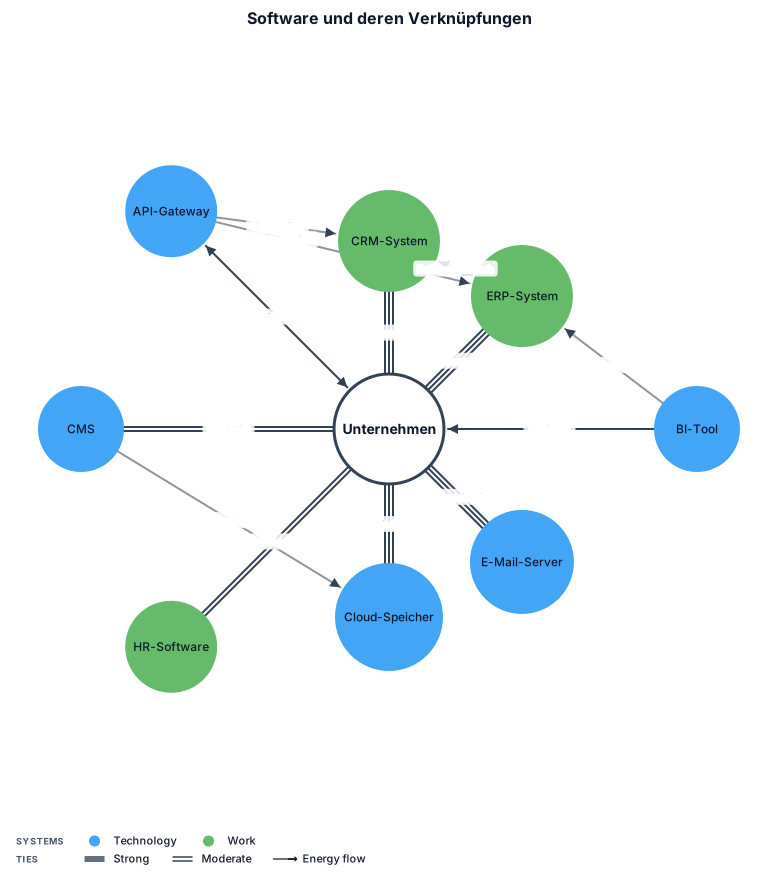
ich brauche eine map im vescheide software und deren verknüfpung darzu stellen
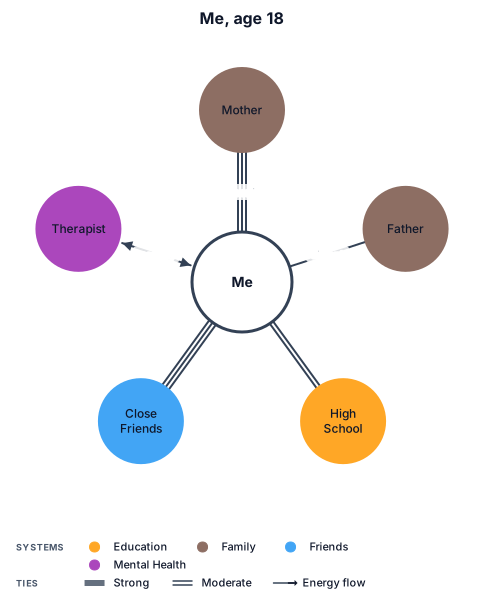
Me, age 18
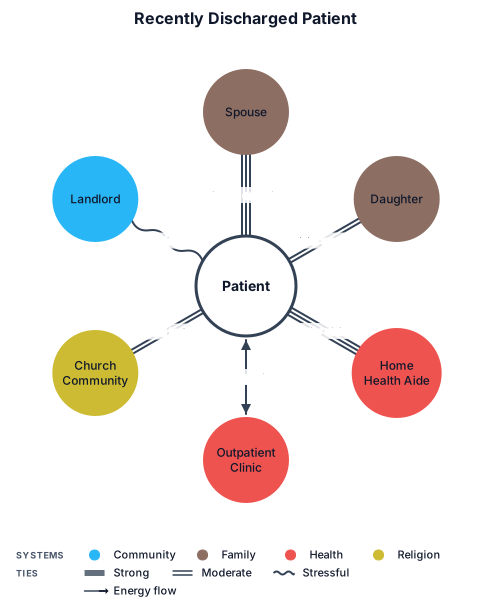
An ecomap for a recently discharged hospital patient showing family support, home health aide, outpatient clinic, church community, and a stressful relationship with their landlord
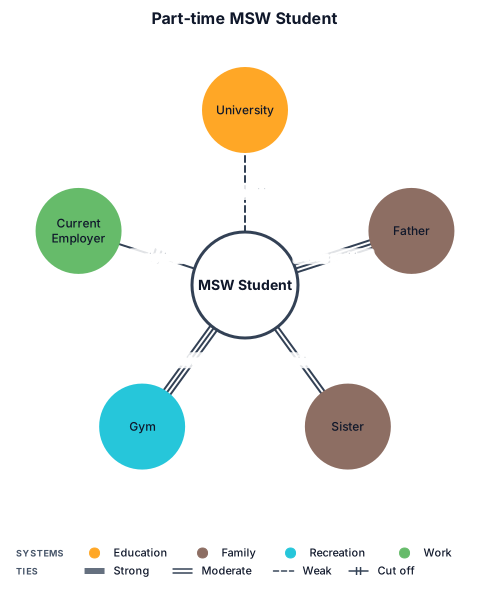
An ecomap for a part-time MSW student with a weak positive relationship to his school, a strong positive relationship with his father, a less strong but still strong and less positive but still positive relationship with his sister, goes to the gym 4/5 times/week individually, an employer he is resigning from.
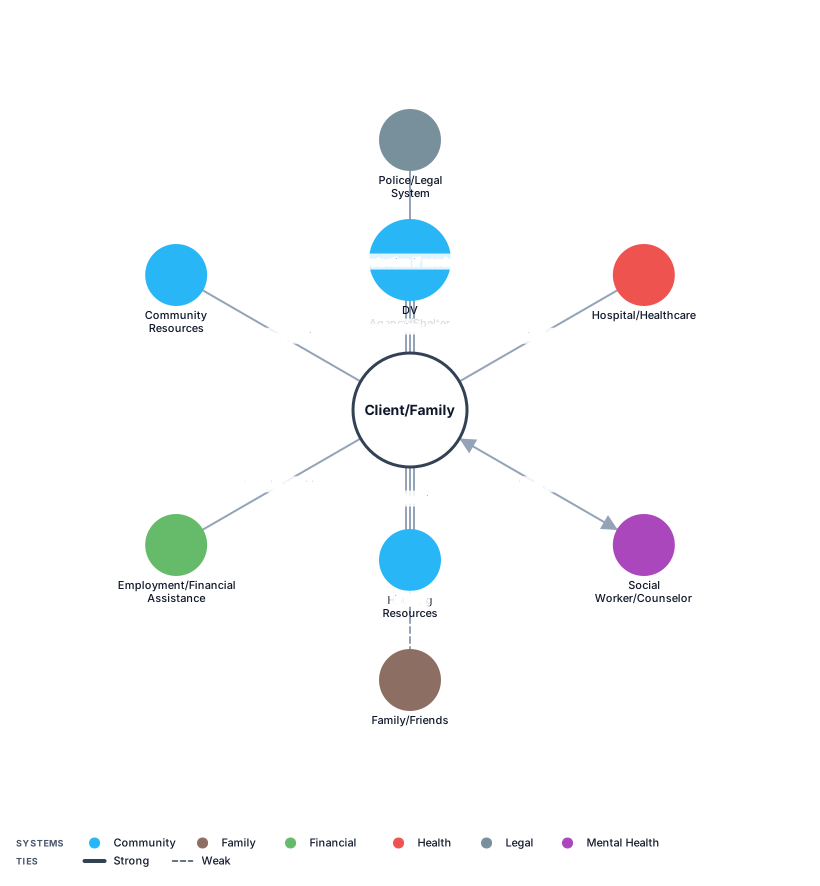
An ecomap for a client/family in the center. Around her, you could connect systems such as: Domestic-violence agency/shelter → safety planning, advocacy, emergency shelter Police/legal system → protection if needed Hospital/healthcare provider → medical care Social worker/counseling → emotional support and assessment Family/friends → informal support, if available and safe Employment/financial assistance → financial stability Housing resources → safe housing Community resources → food, transportation, childcare, etc.
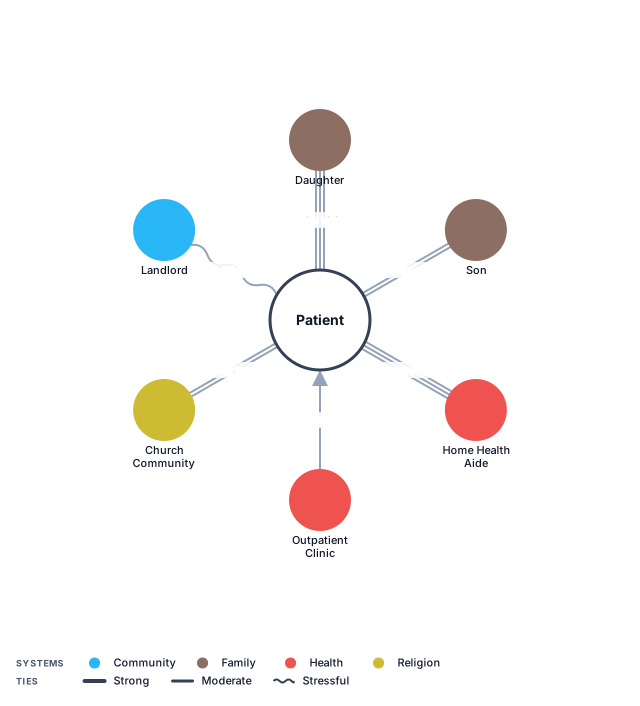
An ecomap for a recently discharged hospital patient showing family support, home health aide, outpatient clinic, church community, and a stressful relationship with their landlord
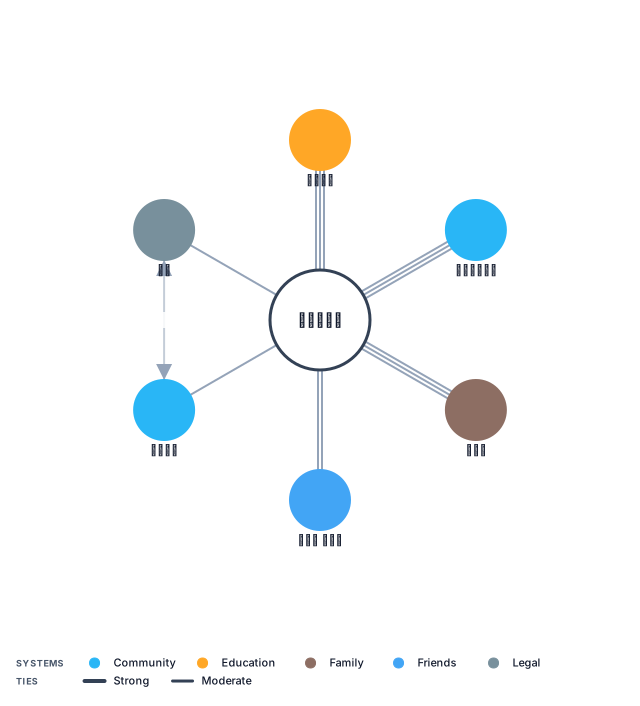
클라이언트 중심으로 지역자원으로는 고등학교와 지역아동센터가 있으며, 사회적 관계로는 할머니와 중학교 친구들이 있음. 공적체계는 주민센터와 구청이 연결되어 있음.
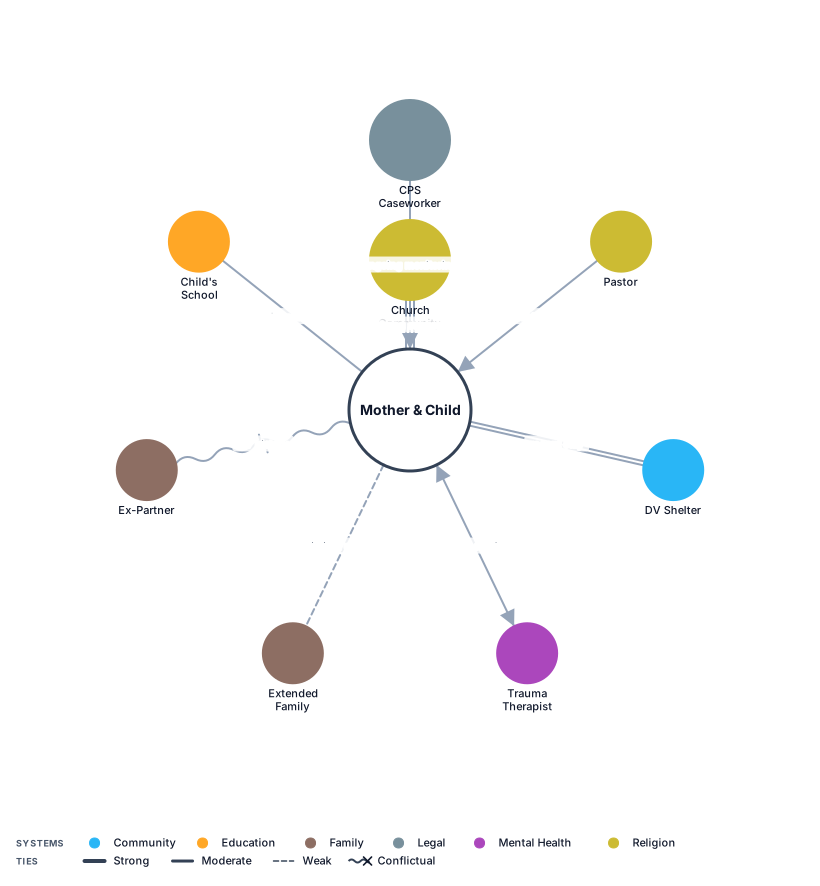
An ecomap for a child welfare case showing a mother with domestic violence history, limited family support, strong church community, and ongoing CPS involvement
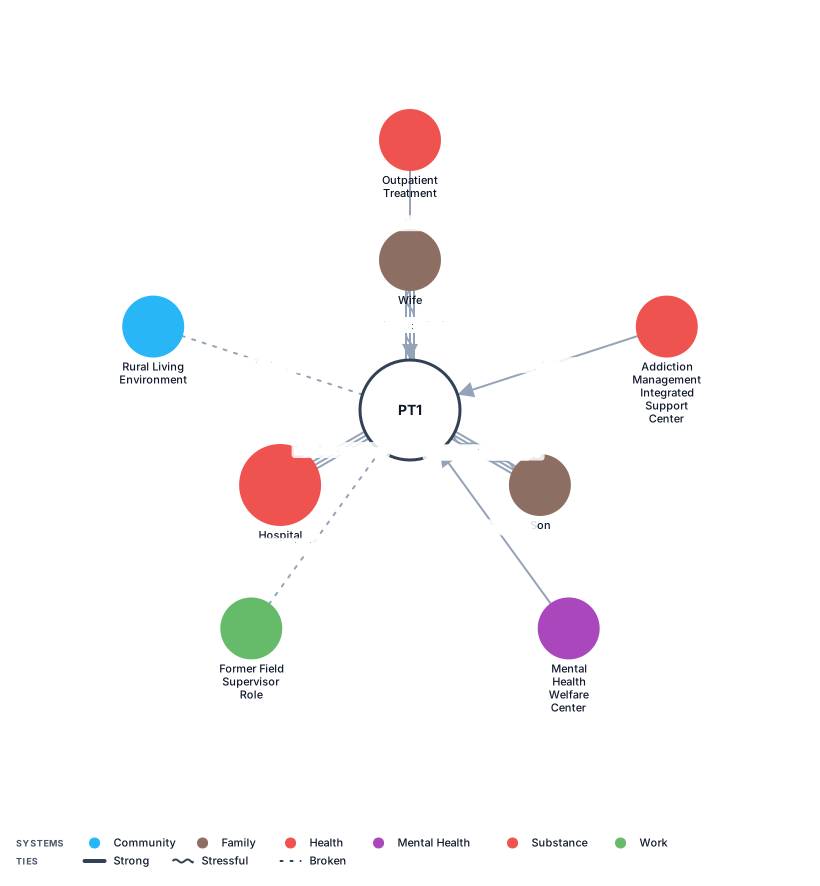
An ecomap for a recently discharged hospital pPT1 is currently connected mainly to the family system and the medical system. His wife and son are aware of his alcohol-related problems, and his son hopes that PT1 will leave the hospital after gaining better control over his drinking. PT1 is conscious of his son’s reactions and experiences psychological pressure within the family relationship. Although the family functions as an important support system, tension and conflict related to PT1’s drinking are also present. The occupational system is more closely related to PT1’s past drinking pattern than to his current support system. PT1 reported that while working as a field supervisor, he often drank alcohol during lunch and after work with other supervisors. After moving to a rural area at age 58, his drinking increased and sometimes began in the morning. Therefore, his previous occupational and living environments can be considered systems that influenced the continuation of his alcohol use. The hospital is currently the primary formal support system providing inpatient treatment and monitoring of his alcohol-related problems. After discharge, connection with community-based resources such as an Addiction Management Integrated Support Center, Mental Health Welfare Center, and outpatient treatment should be considered to support continued alcohol management.atient showing family support, home health aide, outpatient clinic, church community, and a stressful relationship with their landlord
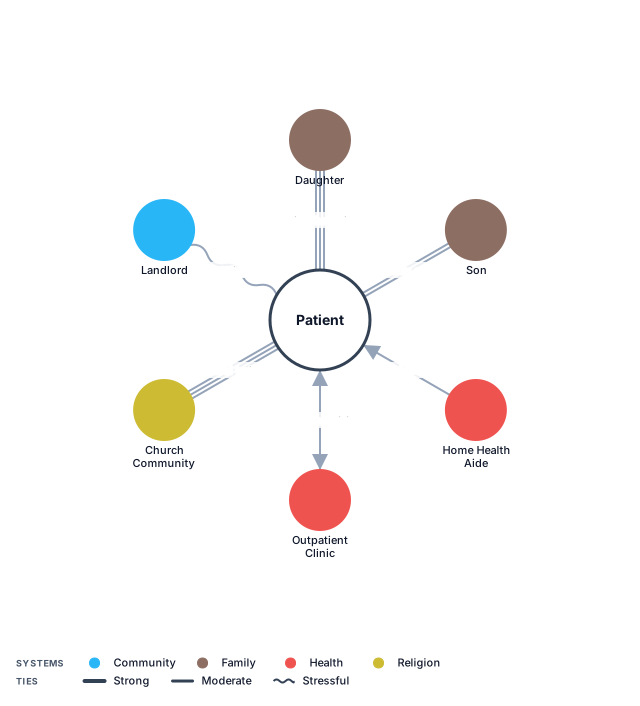
An ecomap for a recently discharged hospital patient showing family support, home health aide, outpatient clinic, church community, and a stressful relationship with their landlord