
Buat flowchart vertikal sederhana untuk Gambar 3.1 Tahap Penelitian skripsi. Gunakan warna hitam putih, latar putih, kotak persegi panjang sederhana, garis dan panah hitam, tanpa ikon, tanpa dekorasi, tanpa warna. Tahapan: Mulai → Studi Literatur → Identifikasi Masalah dan Variabel → Pengumpulan 500 Komentar TikTok → Pelabelan Sentimen Positif, Negatif, Netral → Text Preprocessing (Cleaning, Case Folding, Tokenizing, Stopword Removal, Stemming) → Pembobotan TF-IDF → Pembagian Dataset → Pelatihan Random Forest dan Decision Tree → Pengujian Model → Evaluasi (Accuracy, Precision, Recall, F1-Score) → Analisis Perbandingan Hasil → Implementasi Website → Notifikasi → Selesai. Jangan gunakan SMOTE. Tampilan formal dan cocok untuk skripsi.
NODE ARCHIVE · REAL DIAGRAM BRIEFS
Diagram Examples from Real Visitor Prompts
Browse eligible diagrams shared by FreeDiagram visitors, inspect the exact prompts, and build your own version.
Browse 3312 real creationsCOMMUNITY OUTPUTS · EXACT PROMPTS
All visitor creations
Showing 2041–2064 of 3312. No stock examples or system defaults. Choose a tool, study a real result, then reopen its prompt as your starting point.
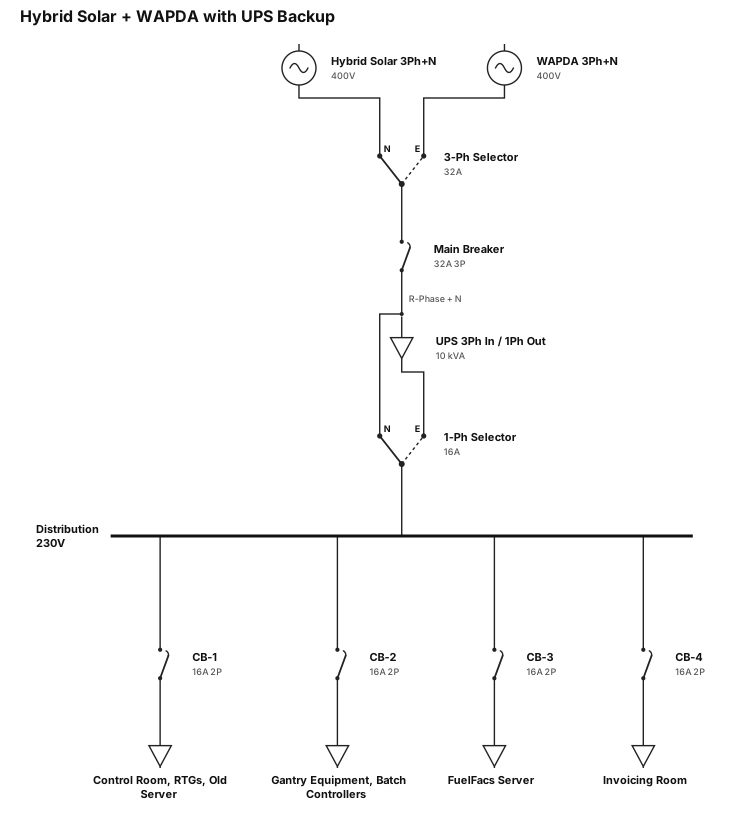
Circuit Description The system comprises two independent 3-phase, 4-wire power sources: Hybrid Solar and WAPDA supply. Both sources are connected to a 3-phase, 4-wire selector/changeover switch, allowing selection of either source for the downstream system. The output of the 3-phase selector is connected to a 3-pole, 32A main circuit breaker. The output of the main breaker is divided into two circuits: UPS Supply: The 3-phase, 4-wire output of the main breaker is connected directly to the input of a 10 kVA UPS. The UPS has a 3-phase input and single-phase output. Normal Supply: The R (Red) phase and Neutral from the main breaker output are connected to one input of a single-phase, 2-source selector/changeover switch. The single-phase output of the 10 kVA UPS is connected to the second input of the same single-phase selector/changeover switch. The selector therefore allows the downstream loads to operate either from the normal R-phase supply or from the UPS output. The output of the single-phase selector is connected to a distribution arrangement comprising four 2-pole, 16A circuit breakers. All four breakers are supplied from the same single-phase source. The connected loads are: CB-1 – 2P, 16A: New Control Room, RTGs and Old Server CB-2 – 2P, 16A: Gantry Equipment including Batch Controllers CB-3 – 2P, 16A: FuelFacs Server CB-4 – 2P, 16A: Invoicing Room In summary: the arrangement provides selectable Hybrid Solar/WAPDA input, with the selected 3-phase supply feeding the 10 kVA UPS and the normal single-phase supply simultaneously available at the final selector. The final selector enables the four critical single-phase load groups to be supplied either through the normal R-phase supply or the UPS output.
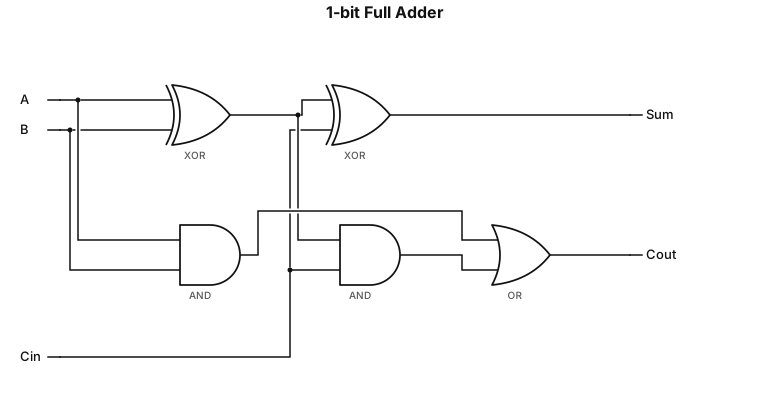
A logic gate circuit for a 1-bit full adder using AND, OR, and XOR gates with inputs A, B, and carry-in, and outputs sum and carry-out.
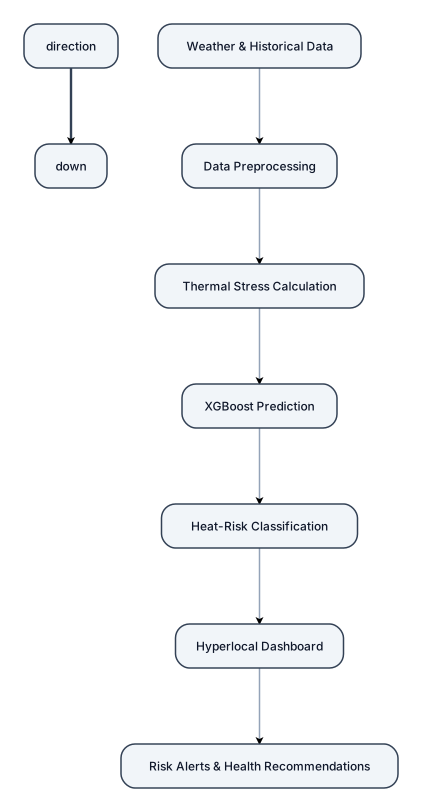
Create a flowchart for HeatGuard AI: Weather & Historical Data → Data Preprocessing → Thermal Stress Calculation → XGBoost Prediction → Heat-Risk Classification → Hyperlocal Dashboard → Risk Alerts & Health Recommendations
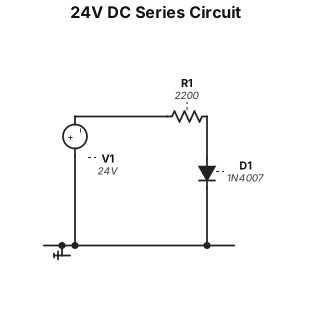
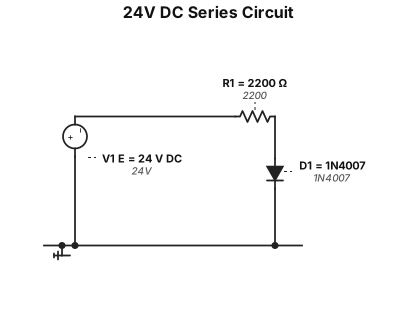
"A clean, standard electrical circuit schematic on a white background. A 24V DC voltage source connected in series with a 2200 Ohm resistor and a 1N4007 silicon diode, ending at a ground connection. Use standard IEEE electronic symbols, crisp black lines, minimalist black-and-white style, no background clutter."
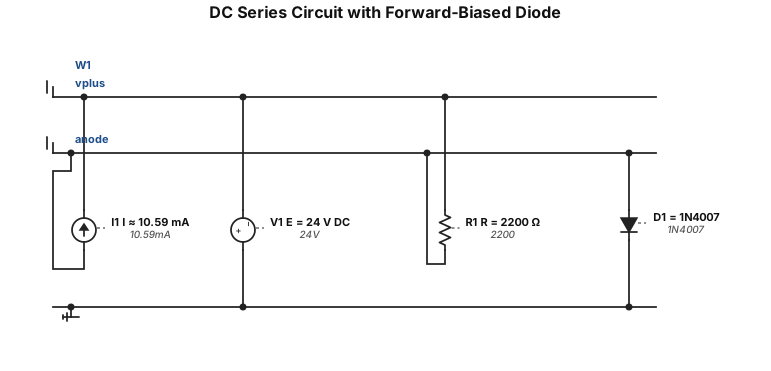
EDIT THE PREVIOUS SCHEMATIC. DO NOT CREATE A NEW CIRCUIT. Keep exactly the same circuit topology, but simplify it to ONLY these components: 1. One DC voltage source: E = 24 V DC 2. One resistor: R1 = 2200 Ω 3. One silicon diode: D1 = 1N4007 4. One GND symbol The ONLY electrical path must be: +24 V DC source -> R1 2200 Ω -> D1 1N4007 -> negative terminal of the same 24 V source. IMPORTANT: - REMOVE the current source I1 completely. - REMOVE all additional voltage/current sources. - REMOVE all extra wires that create parallel branches. - REMOVE labels such as "vplus", "anode", "10.59mA" if they are not part of the standard schematic. - Do not add any capacitor, lamp, switch, fuse, second diode, or second circuit. - Keep exactly ONE source, ONE resistor, and ONE diode. - The diode must be forward biased. - Use standard electrical schematic symbols. - Make the final schematic clean, simple and suitable for a university laboratory report. Show only these component labels: E = 24 V DC R1 = 2200 Ω D1 = 1N4007 Optionally show: I ≈ 10.59 mA U_D = 0.7 V P_D ≈ 7.41 mW
Generate EXACTLY ONE electrical schematic. Do not generate multiple circuits, alternative versions, examples, or additional diagrams. This is for laboratory assignment, option 5. Create ONLY this single DC circuit: 24 V DC voltage source E = 24 V connected in series to R = 2200 ohms resistor connected in series to D1 = 1N4007 silicon diode connected back to the negative terminal of the 24 V source. Circuit topology must be exactly: +24 V DC source -> R1 2200 ohm -> D1 1N4007 -> negative terminal of source. The diode must be FORWARD BIASED: the positive terminal of the 24 V source connects through the resistor to the ANODE of D1; the CATHODE of D1 connects to the negative terminal of the source. Use standard IEC/electrical schematic symbols. Show: - voltage source labeled "E = 24 V DC" - resistor labeled "R = 2200 Ω" - diode labeled "D1 = 1N4007" - ground symbol connected to the negative terminal if appropriate - current direction arrow labeled "I" - diode voltage label "U_D = 0.7 V" - current label "I ≈ 10.59 mA" - diode power label "P_D ≈ 7.41 mW" IMPORTANT: - EXACTLY ONE circuit only - ONLY one voltage source - ONLY one resistor - ONLY one diode - NO bridge rectifier - NO four diodes - NO capacitor - NO lamp - NO switch - NO fuse - NO AC source - NO second circuit - NO alternative circuit - NO additional components - NO decorative electrical diagrams The final result must be a single clean horizontal textbook-style schematic on a white background, suitable for inserting into a university laboratory report.
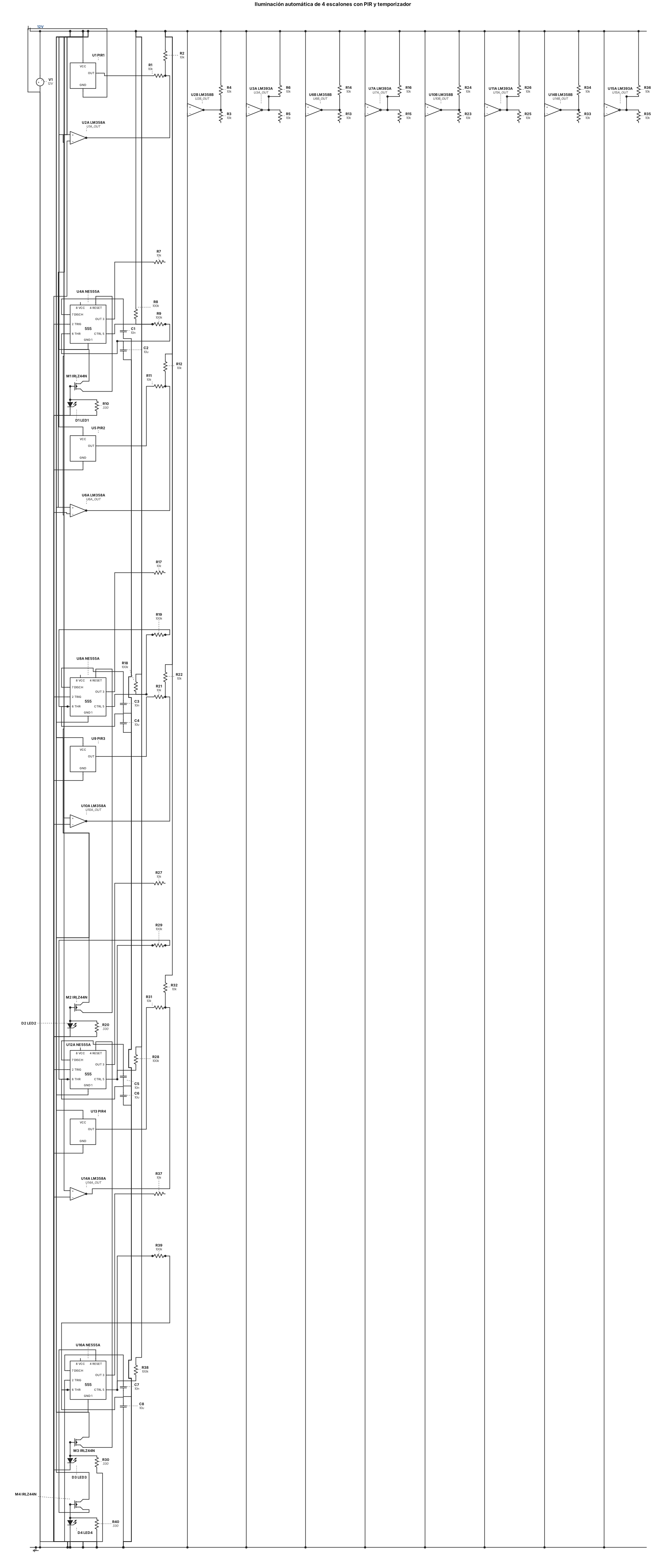
Diseña un sistema de iluminación automática para 4 escalones usando una fuente de 12 V. Cada escalón debe tener un sensor PIR HC-SR501 independiente y una tira LED independiente. Utilizar LM358 para acondicionamiento de señal, LM393 como comparador, NE555 como temporizador e IRLZ44N para controlar cada tira LED. No utilizar Arduino, microcontroladores ni PLC. Todos los canales deben compartir la alimentación de 12 V y GND
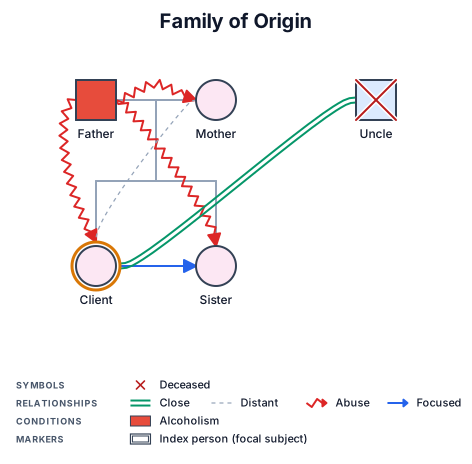
Woman grew up with mother, father and younger sister. Father was an alcoholic. Person felt like parent figure towards younger sister- focused. Father was physically and verbally abusive. Mother provided for physical needs but emotionally unsupportive. Very supportive relationship with paternal uncle, now deceased. Unhealthy relationship between parents- father was abusive to mother.
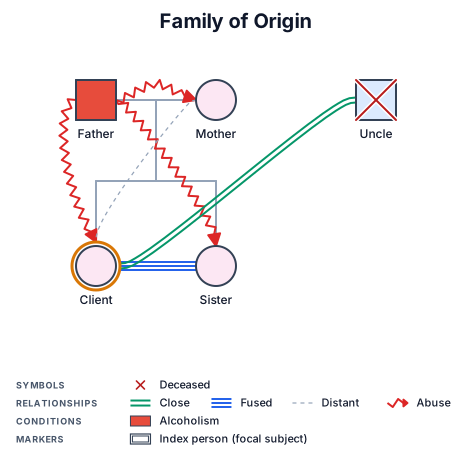
Woman grew up with mother, father and younger sister. Father was an alcoholic. Person felt like parent figure towards younger sister- enmeshed. Father was physically and verbally abusive. Mother provided for physical needs but emotionally unsupportive. Very supportive relationship with paternal uncle, now deceased. Unhealthy relationship between parents- father was abusive to mother.
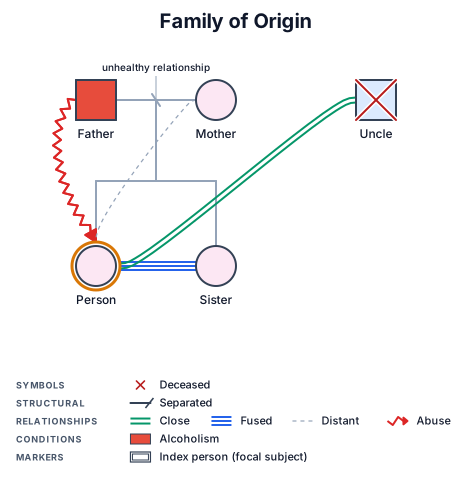
Woman grew up with mother, father and younger sister. Father was an alcoholic. Person felt like parent figure towards younger sister- enmeshed. Father was physically and verbally abusive. Mother provided for physical needs but emotionally unsupportive. Very supportive relationship with paternal uncle, now deceased. Unhealthy relationship between parents.
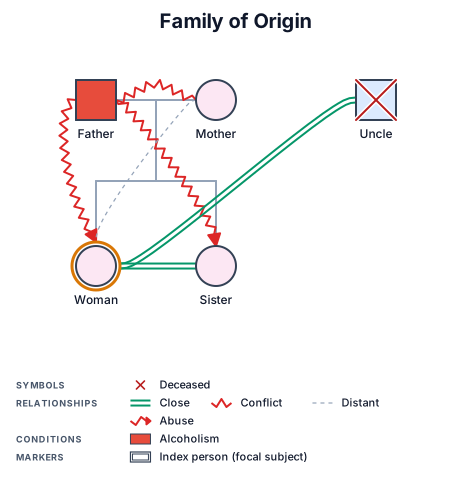
Woman grew up with mother, father and younger sister. Father was an alcoholic. Person felt like parent figure towards younger sister. Woman felt worried around father. Father was physically and verbally abusive. Mother provided for physical needs but emotionally unsupportive. Very supportive relationship with paternal uncle, now deceased. Unhealthy relationship between parents.
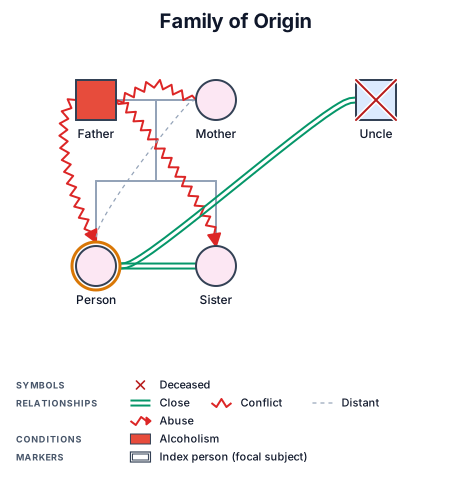
Woman grew up with mother, father and younger sister. Father was an alcoholic. Person felt like parent figure towards younger sister. Father was physically and verbally abusive. Mother provided for physical needs but emotionally unsupportive. Very supportive relationship with paternal uncle, now deceased. Unhealthy relationship between parents.
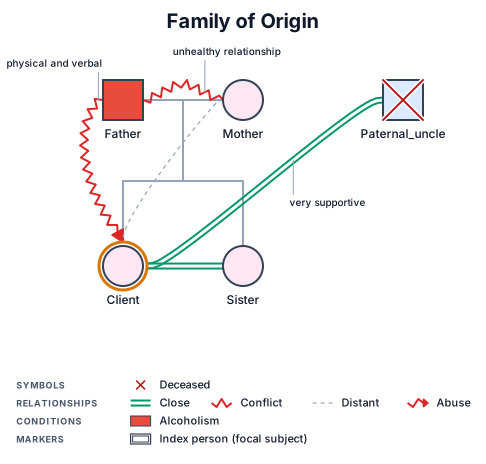
Woman grew up with mother, father and younger sister. Father was an alcoholic. Person felt like mother towards their sister. Father was physically and verbally abusive. Mother provided for physical needs but emotionally unsupportive. Very supportive relationship with paternal uncle, now deceased. Unhealthy relationship between parents.
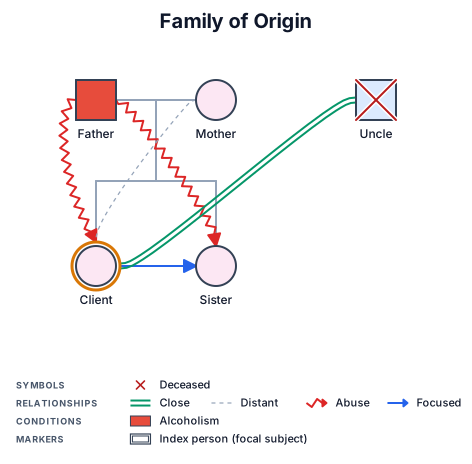
Woman grew up with mother, father and younger sister. Father was an alcoholic. Person felt like mother towards their sister. Father was physically and verbally abusive. Mother provided for physical needs but emotionally unsupportive. Very supportive relationship with paternal uncle, now deceased.
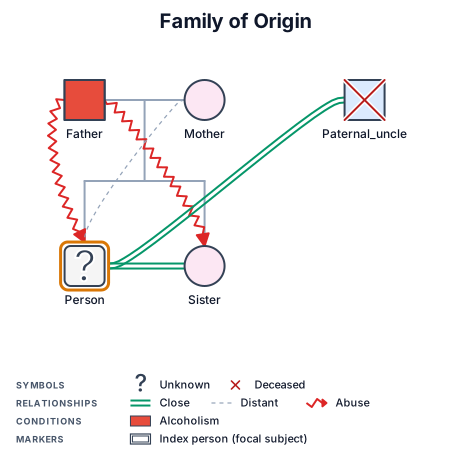
Person grew up with mother, father and younger sister. Father was an alcoholic. Person felt like mother towards their sister. Father was physically and verbally abusive. Mother provided for physical needs but emotionally unsupportive. Very supportive relationship with paternal uncle, now deceased.
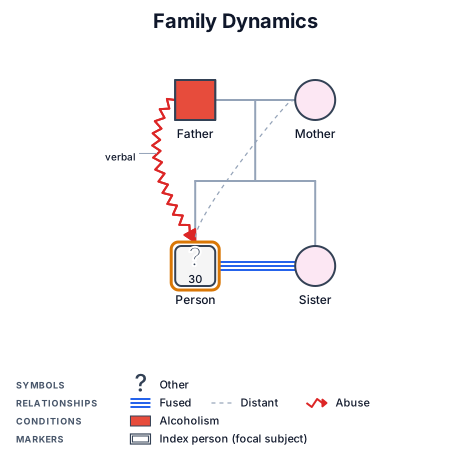
Person is 30 years-old and grew up with mother, father and younger sister. Father was an alcoholic. Person felt like mother towards their sister. Father was physically and verbally abusive. Mother provided for physical needs but emotionally unsupportive.
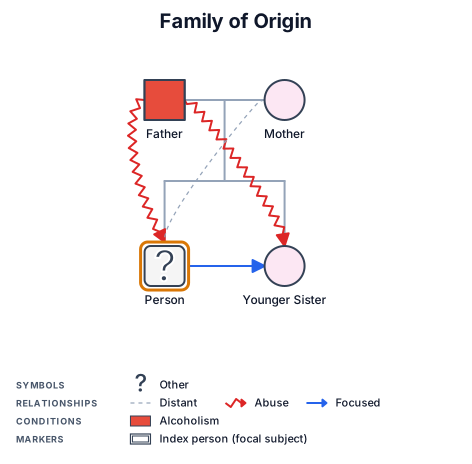
Person grew up with mother, father and younger sister. Father was an alcoholic. Person felt like mother towards their sister. Father was physically and verbally abusive. Mother provided for physical needs but emotionally unsupportive.
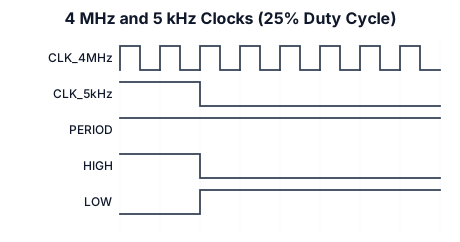
A timing diagram for a 4 MHz and 5 kHz with 25% duty cycle clock signals, annotate the 5 kHz signal period & logic high/low durations.
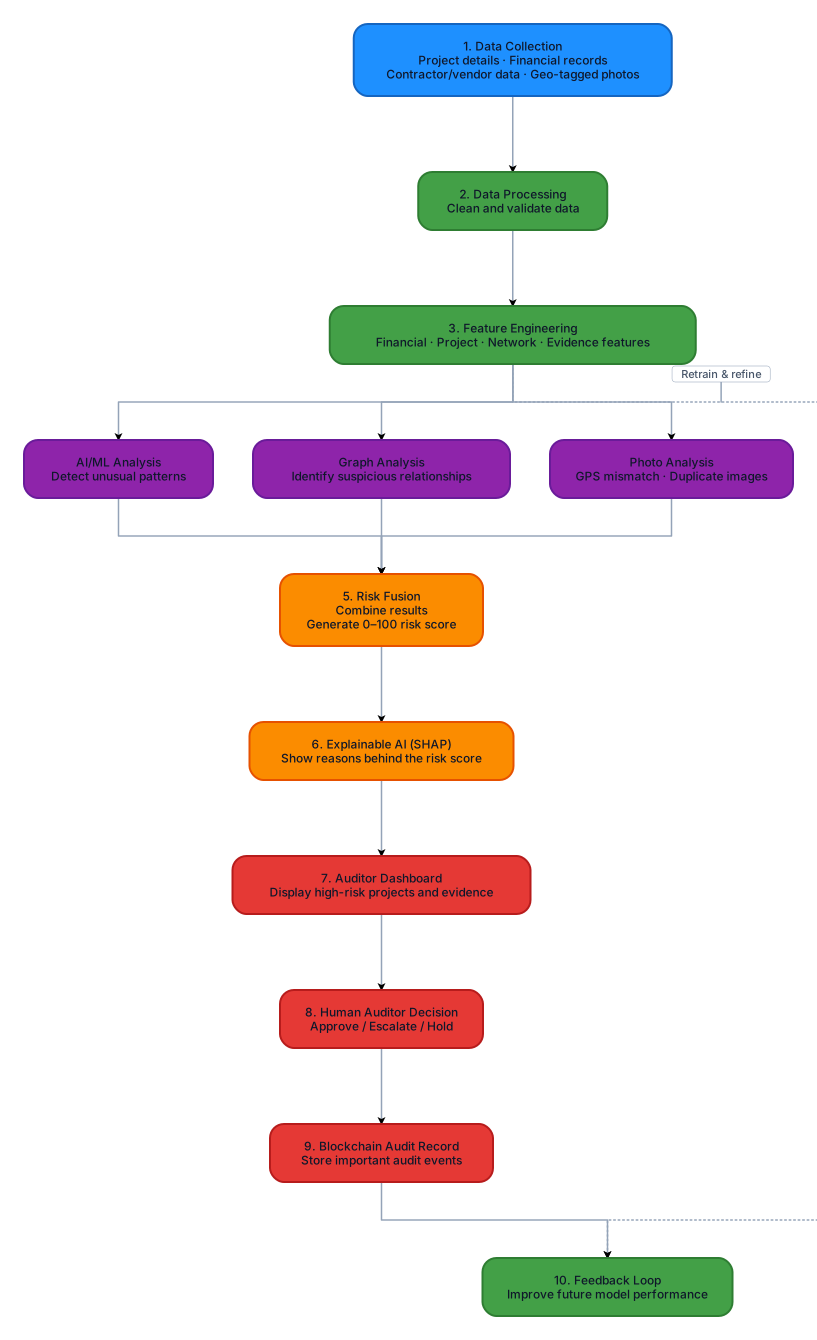
Create a professional, colourful, and easy-to-understand methodology flowchart for my Smart India Hackathon project VIGIL-AI – AI-Powered MPLADS Fraud Detection & Audit System. Title: VIGIL-AI Methodology / Process Flow Create a top-to-bottom flowchart with these important steps: 1. Data Collection - Project details - Financial records - Contractor/vendor data - Geo-tagged photos 2. Data Processing - Clean and validate data 3. Feature Engineering - Financial, project, network, and evidence features 4. Parallel Detection - AI/ML Analysis: detect unusual patterns - Graph Analysis: identify suspicious relationships - Photo Analysis: check GPS mismatch and duplicate images 5. Risk Fusion - Combine results - Generate 0–100 risk score 6. Explainable AI (SHAP) - Show reasons behind the risk score 7. Auditor Dashboard - Display high-risk projects and evidence 8. Human Auditor Decision - Approve / Escalate / Hold 9. Blockchain Audit Record - Store important audit events 10. Feedback Loop - Improve future model performance Design requirements: - Use a clean, modern hackathon presentation style. - Use rounded boxes and clear arrows. - Use colours: blue for data, green for processing, purple for AI, orange for risk analysis, and red for auditing. - Keep only important points; avoid long paragraphs. - Show AI detection as three parallel branches. - Add the note: “AI Recommends; Auditor Decides.” - Make the flowchart suitable for a PowerPoint slide.
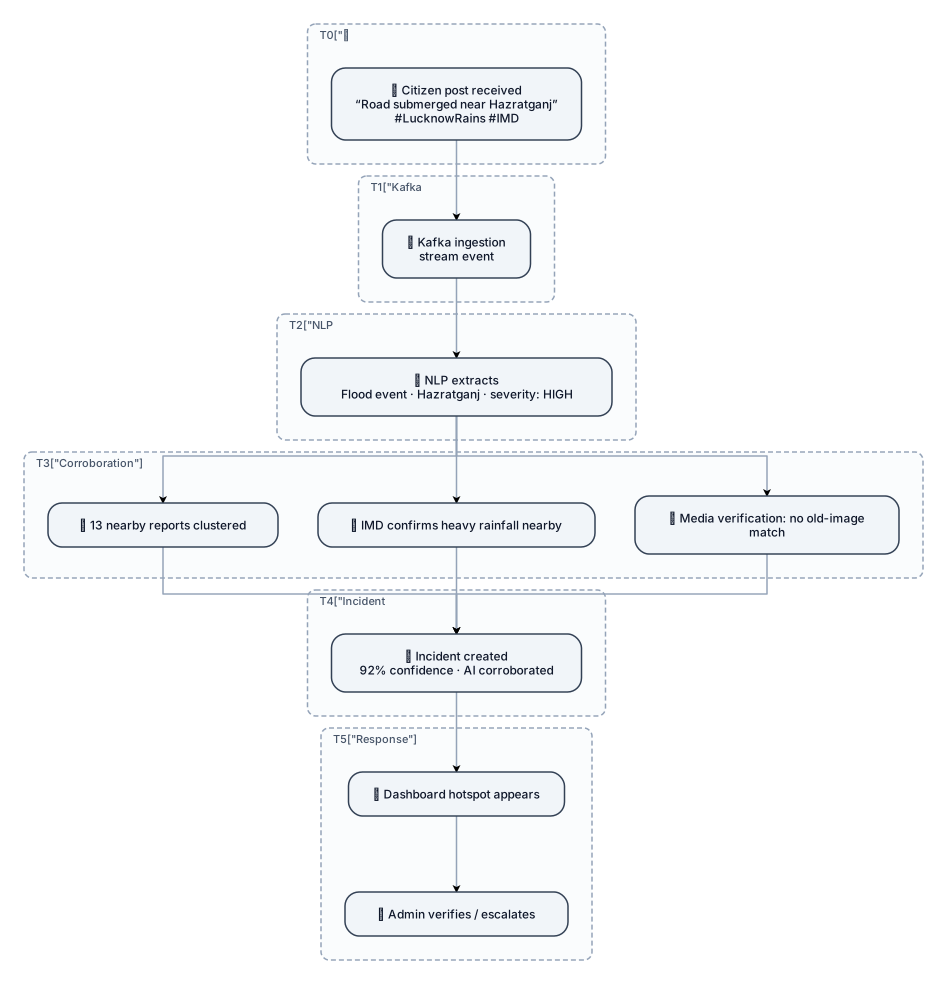
7-SECOND HAZRATGANJ FLOOD STORY (4:17 PM) Citizen post received: "Road submerged near Hazratganj #LucknowRains #IMD" Kafka ingestion NLP extracts: Flood event, Location: Hazratganj, severity: High 13 nearby reports clustered IMD data confirms heavy rainfall nearby Media verification finds no old-image match Incident created with 92% confidence, AI corroborated Dashboard hotspot appears; admin verifies/escalates "Make it look visually engaging and more impressive "
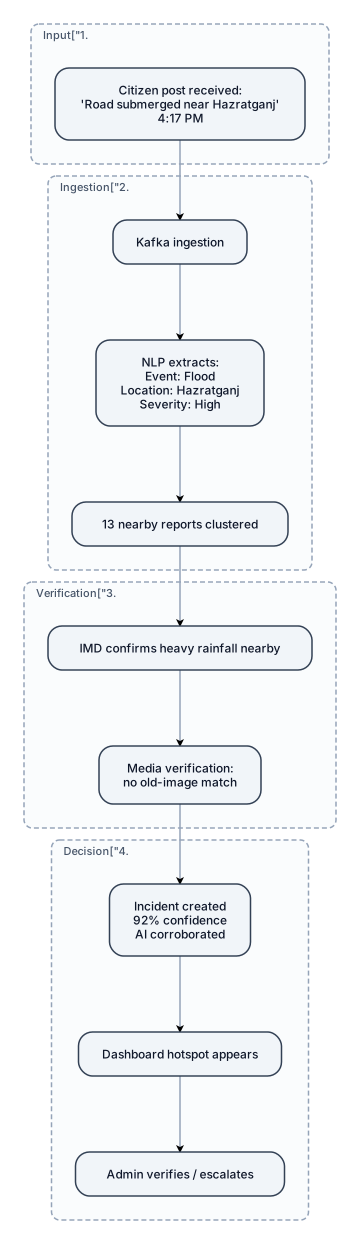
7-SECOND HAZRATGANJ FLOOD STORY (4:17 PM) Citizen post received: "Road submerged near Hazratganj #LucknowRains #IMD" Kafka ingestion NLP extracts: Flood event, Location: Hazratganj, severity: High 13 nearby reports clustered IMD data confirms heavy rainfall nearby Media verification finds no old-image match Incident created with 92% confidence, AI corroborated Dashboard hotspot appears; admin verifies/escalates
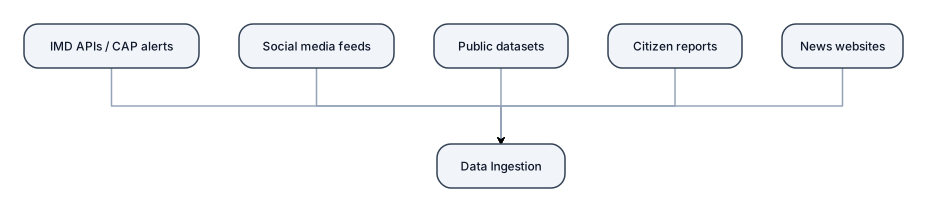
Inputs IMD APIs / CAP alerts Social media feeds Public datasets Citizen reports Citizen reports News websites
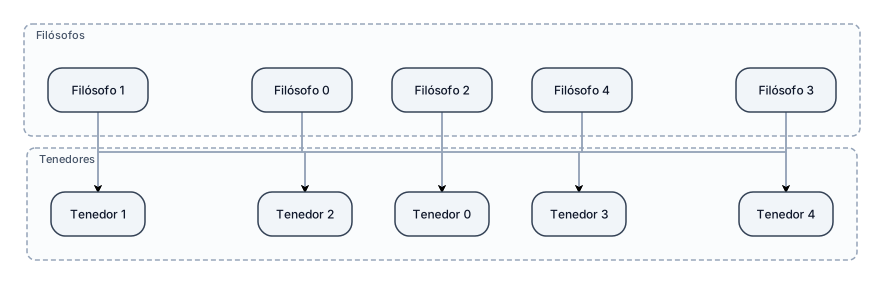
import threading import time import random N = 5 # Cantidad de filósofos y tenedores # Creamos un semáforo por cada tenedor (1 indica disponible) tenedores = [threading.Semaphore(1) for _ in range(N)] def filosofo(id): for _ in range(2): # Cada filósofo comerá 2 veces en la simulación print(f"Filósofo {id} está pensando...") time.sleep(random.uniform(0.3, 0.8)) tenedor_izq = id tenedor_der = (id + 1) % N # ESTRATEGIA: El último filósofo agarra los tenedores al revés para evitar el deadlock if id == N - 1: tenedores[tenedor_der].acquire() # Bloquea tenedor derecho tenedores[tenedor_izq].acquire() # Bloquea tenedor izquierdo else: tenedores[tenedor_izq].acquire() # Bloquea tenedor izquierdo tenedores[tenedor_der].acquire() # Bloquea tenedor derecho # SECCIÓN CRÍTICA: Comer print(f" -> Filósofo {id} está COMIENDO") time.sleep(0.5) # LIBERACIÓN DE RECURSOS tenedores[tenedor_izq].release() # Libera tenedor izquierdo tenedores[tenedor_der].release() # Libera tenedor derecho # Creación e inicio de hilos (procesos) hilos = [] for i in range(N): t = threading.Thread(target=filosofo, args=(i,)) hilos.append(t) t.start() for t in hilos: t.join()